

Birds of Vietnam, Bird Species in Vietnam
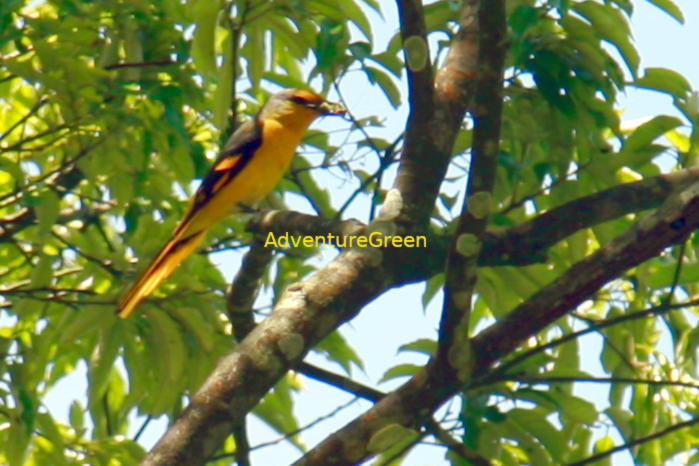
Let's join AdventureGreen on our bird quests to learn about the different birds and bird species in Vietnam. Here you can find out more about the birding spots that these bird species are found.
- Order: Passeriformes
- Family: Aegithalidae
- Genus: Aegithalos
Black-Throated Bushtit, also known as the black-throated tit or red-headed tit
(Bạc má đuôi dài, Aegithalos concinnus)
The black-throated bushtit (Aegithalos concinnus), also known as the black-throated tit, is a very small passerine bird in the family Aegithalidae.
This bird is found from the foothills of the Himalayas, stretching across northern India through north-eastern Bangladesh, Nepal, Bhutan, northern Myanmar, Vietnam, and Taiwan, Cambodia.
Grey-Crowned Tit (Aegithalos Annamensis) found in Da Lat (Central Highlands of Vietnam), which does not have a chestnut-colored cap, remains to be separated from the Black-Throated Bushtit.
Aegithalidae: the Ancient Greek word aegithalos for a tit.
concinnus: con +cinnus: neat, elegant, clever; pretty, pleasing.
- Order: Passeriformes
- Family: Aegithalidae
- Genus: Aegithalos
Black-browed tit (Aegithalos iouschistos), also known as the black-browed bushtit or rufous-fronted bushtit
The black-browed tit (Aegithalos iouschistos) is a species of bird in the family of long-tailed tit Aegithalidae.
This bird species is found in mid-southern China and sporadically in Myanmar.
Aegithalidae: the Ancient Greek word aigithalos for a tit.
iouschistos:
Ancient Greek: (ioeis), meaning "violet-colored" or "dark".
Late Latin schistus borrowed from the Greek schistos, meaning "slate" or "split".
- Order: Passeriformes
- Family: Leiothrichidae
- Genus: Heterophasia
Black-Headed Sibia
(Heterophasia desgodinsi)
Mi đầu đen
The black-headed sibia (Heterophasia desgodinsi) is a bird species in the family Leiothrichidae.
- Order: Passeriformes
- Family: Leiothrichidae
- Genus: Heterophasia
Dark-backed sibia
(Mi lưng đen, Heterophasia melanoleuca)
The dark-backed sibia (Heterophasia melanoleuca) is a bird species in the family Leiothrichidae.
The bird is found in China, Myanmar and Thailand.
Heterophasia, Hetero: derives from the Greek word heteros meaning "different" or "other".
Melanoleuca: Greek melas black; leukos Greek white.
-phasia: New Latin, from Greek, speech, from phasis utterance, from phanai to speak, say.
- Order: Passeriformes
- Family: Leiothrichidae
- Genus: Heterophasia
Long-tailed sibia
(Mi đuôi dài, Heterophasia picaoides)
The long-tailed sibia (Heterophasia picaoides) is a species of Leiothrichidae from Southeast Asia.
Heterophasia, Hetero: derives from the Greek word heteros meaning "different" or "other".
-phasia: New Latin, from Greek, speech, from phasis utterance, from phanai to speak, say.
picaoides: From genus Pica Brisson, magpie; Greek -oides: resembling (Heterophasia).
- Order: Passeriformes
- Family: Leiothrichidae
- Genus: Laniellus
Grey-Crowned Crocias
(Mi Núi Bà, Laniellus langbianis)
endemic to Vietnam, restricted to the Di Linh Plateau.
The gray-crowned crocias (Laniellus langbianis) is a passerine bird in the family Leiothrichidae.
Leiothrix Leiothrichidae: Ancient Greek leios meaning "smooth" and thrix meaning "hair".
Laniellus possibly from Latin Lanius: "butcher".
Ancient Greek κροκίας or krokías: “a saffron-colored stone”.
- Order: Cuculiformes
- Family: Cuculidae
- Genus: Surniculus
Square-Tailed Drongo-Cuckoo
(Cu cu đen, Surniculus lugubris)
The square-tailed drongo-cuckoo (Surniculus lugubris) is a species of cuckoo that resembles a black drongo.
lugubris: mournful, doleful, plaintive, sinister...
culus: ass, arse, anus,
- Order: Cuculiformes
- Family: Cuculidae
- Genus: Surniculus
Fork-tailed drongo-cuckoo (Surniculus dicruroides)
The fork-tailed drongo-cuckoo (Surniculus dicruroides) is a species of cuckoo that resembles the Black drongo (Dicrurus macrocercus).
Surniculus: possibly from French Surnicou: sournois deceitful; Coucou cuckoo. It is also likely a portmanteau of the genus name Surnia (owl) and Cuculus (cuckoo). It can also be interpreted from Latin as a combination of surnos (or sournos) for "deceitful" and cuculus for "cuckoo," referencing the bird's deceptive nature.
culus: In Latin, "culus" is a vulgar word meaning "buttocks," "posterior," or "anus". The Latin suffix -culus is a diminutive suffix used to mean "little" or "small," similar to the function of suffixes in both Latin and English.
The suffix "-oides" in dicruroides is from Greek and Latin, as part of the Greek word "-eides" (meaning "like" or "in the form of"), combined with "Dicrurus," a genus name derived from Greek. The genus name Dicrurus itself comes from the Greek words "dikros" (forked) and "oura" (tail).
The name dicruroides literally translates to "like a drongo" or "in the form of a drongo," referring to the fact that the Fork-tailed Drongo-Cuckoo (Surniculus dicruroides) resembles a drongo.
- Order: Galliformes
- Family: Phasianidae
- Genus: Arborophila
Bar-Backed Partridge, also known as the brown-breasted hill-partridge
(Gà so họng trắng, Arborophila brunneopectus)
The bar-backed partridge (Arborophila brunneopectus), also known as the brown-breasted hill-partridge, is a species of partridge in the family Phasianidae.
Phasianidae from Phasianus: Latin for "pheasant", derived from the Ancient Greek φἀσιἀνος, phāsiānos, meaning "(bird) of the Phasis", the River Phasis (now the Rioni) in Colchis on the east coast of the Black Sea (now western Georgia).
Arborophila: the Latin arbor, arboris meaning "tree" with the Ancient Greek philos meaning "-loving".
brunneopectus: brunneus brown; pectus: breast.
- Order: Coraciiformes
- Family: Meropidae
- Genus: Nyctyornis
Blue-Bearded Bee-Eater
(Trảu lớn, Nyctyornis athertoni)
The blue-bearded bee-eater (Nyctyornis athertoni) is a species of bee-eater found in much of the Indian subcontinent and parts of Southeast Asia.
Meropidae: from Merops, the Ancient Greek for "bee-eater".
The genus name Nyctyornis comes from the Ancient Greek nukt meaning nocturnal or night and ornis meaning bird.
- Order: Coraciiformes
- Family: Coraciidae
- Genus: Coracias
Indian Roller
(Sả rừng, Coracias benghalensis)
The Indian roller (Coracias benghalensis) is a bird of the family Coraciidae.
The Indochinese roller (Coracias affinis) and the Indian roller (Coracias benghalensis) are very similar in appearance; the former seems to have brighter blue than the latter.
Coracias is a genus of the rollers, an Old World family of near passerine birds related to the kingfishers and bee-eaters.
The genus name Coracias is from Ancient Greek korakías (κορακίας), derived from korax (κόραξ, ‘raven, crow’).
- Order: Piciformes
- Family: Megalaimidae
- Genus: Psilopogon
Lineated Barbet
(Thầy chùa bụng nâu, cu rốc bụng nâu, Psilopogon lineatus)
The lineated barbet (Psilopogon lineatus) is an Asian barbet native to the Terai (Indian Continent), the Brahmaputra basin (Tibet), to Southeast Asia.
Megalaima means ‘large throat’ in Greek.
The name Psilopogon combines the Ancient Greek psilos meaning "bare" and pōgōn meaning "beard".