

Birds of Vietnam, Bird Species in Vietnam
Let's join AdventureGreen on our bird quests to learn about the different birds and bird species in Vietnam. Here you can find out more about the birding spots that these bird species are found.
- Order: Passeriformes
- Family: Muscicapidae
- Genus: Cyornis
Pale-chinned flycatcher (Cyornis poliogenys)
also pale-chinned blue flycatcher, Brook's flycatcher
The pale-chinned flycatcher (Cyornis poliogenys) is a species of bird in the family Muscicapidae.
The bird is found in Bangladesh, Bhutan, China, India, Myanmar, and Nepal.
The nesting season is April–June.
Muscicapidae: Muscicapa comes from the Latin musca meaning a fly, and capere to catch.
Cyornis combines the Ancient Greek kuanos meaning "dark-blue" with ornis meaning "bird".
- Order: Passeriformes
- Family: Rhipiduridae
- Genus: Rhipidura
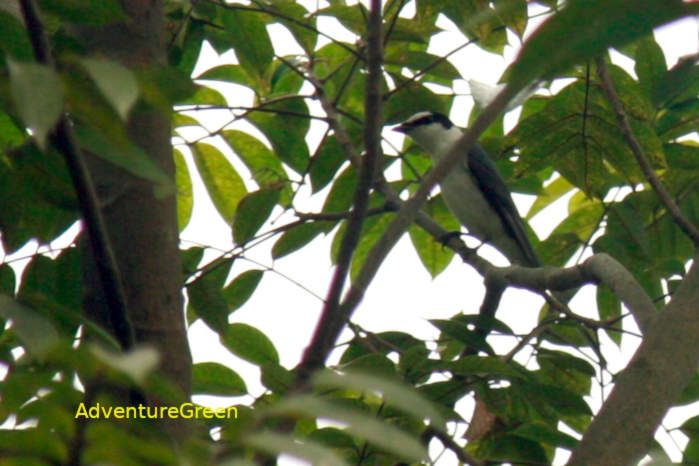
White-throated fantail
(Rẻ quạt họng trắng, Rhipidura albicollis)
The white-throated fantail (Rhipidura albicollis) is a small passerine bird.
- Order: Passeriformes
- Family: Dicruridae
- Genus: Dicrurus
Lesser racket-tailed drongo
(Chèo bẻo cờ đuôi bằng, Dicrurus remifer)
The lesser racket-tailed drongo (Dicrurus remifer) is a species of bird in the family Dicruridae.
The bird is found in the Indian Subcontinent and Southeast Asia: Bangladesh, Bhutan, Cambodia, India, Indonesia, Laos, Malaysia, Myanmar, Nepal, Thailand, and Vietnam.
Compare:
- Greater racket-tailed drongo: has a crest, tail not square cut;
- Lesser racket-tailed drongo : no crest, tail square cut
Dicruridae or Dicrurus is derived from the Greek words dikros meaning forked, ouros meaning tailed.
remifer: Latin remus, remi oar; -fer bearing (ferre to bear).
- Order: Passeriformes
- Family: Dicruridae
- Genus: Dicrurus
Ashy drongo
(Chèo bẻo xám, Dicrurus leucophaeus)
The ashy drongo (Dicrurus leucophaeus) is a species of bird in the drongo family Dicruridae.
- Order: Passeriformes
- Family: Turdidae
- Genus: Cochoa
Purple cochoa (Cochoa purpurea)
Cô cô đầu xám
The purple cochoa (Cochoa purpurea) is a brightly coloured bird found in the temperate forests of Asia.
previously included in the Old World flycatcher family Muscicapidae.
Turdidae, Turdus: Latin for "thrush".
cochoa: from cocho, Nepali for Cochoa purpurea.
purpurea: Latin purpureus purple-coloured (purpur purple).
- Order: Piciformes
- Family: Megalaimidae
- Genus: Psilopogon
Yellow-eared barbet
(Cu rôc tai vàng, Psilopogon australis)
The yellow-eared barbet (Psilopogon australis) is an Asian barbet native to Java and Bali.
Traits:
- Yellow-cheeked;
- Blue-patched;
Megalaima means ‘large throat’ in Greek.
The name Psilopogon combines the Ancient Greek psilos meaning "bare" and pōgōn meaning "beard".
- Order: Piciformes
- Family: Megalaimidae
- Genus: Psilopogon
Blue-throated barbet
(Cu rốc đầu đỏ, Psilopogon asiaticus)
The blue-throated barbet (Psilopogon asiaticus) is a green Asian barbet native to the foothills of the Himalayas and Southeast Asia.
Traits:
- Green-bodied;
- Blue-throated;
- Red-capped, red-crowned;
- Red-fronted;
- Two red stains between the neck and breast;
Megalaima means ‘large throat’ in Greek.
The name Psilopogon combines the Ancient Greek psilos meaning "bare" and pōgōn meaning "beard".
- Order: Piciformes
- Family: Megalaimidae
- Genus: Psilopogon
Moustached barbet
(Cu rốc tai đen, Psilopogon incognitus)
The moustached barbet (Psilopogon incognitus) is an Asian barbet, a resident breeder in the hills of Myanmar, Thailand, Cambodia, Laos and Vietnam.
Traits:
- Green-bodied;
- Red-fronted;
- Black-lined cheeks and behind ears;
- Bristle-bill-based;
Megalaima means ‘large throat’ in Greek.
The name Psilopogon combines the Ancient Greek psilos meaning "bare" and pōgōn meaning "beard".
incognita, incognitus: Latin for unknown, not identified.
- Order: Piciformes
- Family: Megalaimidae
- Genus: Psilopogon
Black-browed barbet
(Cu rốc mày đen, Psilopogon oorti)
The black-browed barbet (Psilopogon oorti) is an Asian barbet native to Peninsular Malaysia and Sumatra.
Traits:
- Green-bodied;
- Black-browed;
- Red-fronted, yellow-fronted;
- Bristle-bill-based;
- Yellow-throated, blue-throated;
Piciformes, picidae, picus: woodpecker
Megalaima means ‘large throat’ in Greek.
The name Psilopogon combines the Ancient Greek psilos meaning "bare" and pōgōn meaning "beard".
- Order: Piciformes
- Family: Megalaimidae
- Genus: Psilopogon
Great barbet
(Thầy chùa lớn, Psilopogon virens)
The great barbet (Psilopogon virens) is an Asian barbet native to the Indian sub-continent and Southeast Asia.
The bird ranges across northern Pakistan, India, Nepal and Bhutan, Bangladesh and some parts of Southeast Asia, Laos.
Traits:
- Black-headed;
- Olived-mantled;
- Green lower-bodied;
- Pale-billed, yellow-billed;
- Red-vented;
- Bristle-bill-based;
- Yellow-throated, blue-throated;
Piciformes, picidae, picus: woodpecker
Megalaima means ‘large throat’ in Greek.
The name Psilopogon combines the Ancient Greek psilos meaning "bare" and pōgōn meaning "beard".
virens: Latin for green.
- Order: Piciformes
- Family: Megalaimidae
- Genus: Psilopogon
Golden-throated barbet
(Cu rốc đầu vàng, Psilopogon franklinii)
The golden-throated barbet (Psilopogon franklinii) is an Asian barbet. The bird species is found in Nepal, India, Bhutan, Myanmar, Thailand, Malaysia, Laos, Vietnam and mainland China.
Piciformes, picidae, picus: Latin woodpecker; Greek pikos: woodpecker.
Megalaima means ‘large throat’ in Greek: megalos great; laimos throat.
The name Psilopogon combines the Ancient Greek psilos meaning "bare" and pōgōn meaning "beard".
- Order: Passeriformes
- Family: Timaliidae
- Genus: Cyanoderma
Chestnut-winged babbler (Khướu bụi bụng trắng, Cyanoderma erythropterum)
The chestnut-winged babbler (Cyanoderma erythropterum) is a babbler species in the family Timaliidae.
The bird is found in the Malay Peninsula from southern Thailand to Singapore, and in Sumatra as well as neighboring countries.
Timaliidae, Timalia: The word "Timalo" originates in the Greek "Thimalos", which means "bird". This Greek root was adapted to Latin as "Timalus" and later to Portuguese as "Timalo".
The genus name Cyanoderma combines the Ancient Greek kuanos meaning "dark-blue" with derma meaning "skin".
Erythropterum is a scientific name derived from Ancient Greek, combining ἐρῠθρός (erythrós, meaning "red") and πτερόν (pterón, meaning "wing"), so it means "red-winged".