

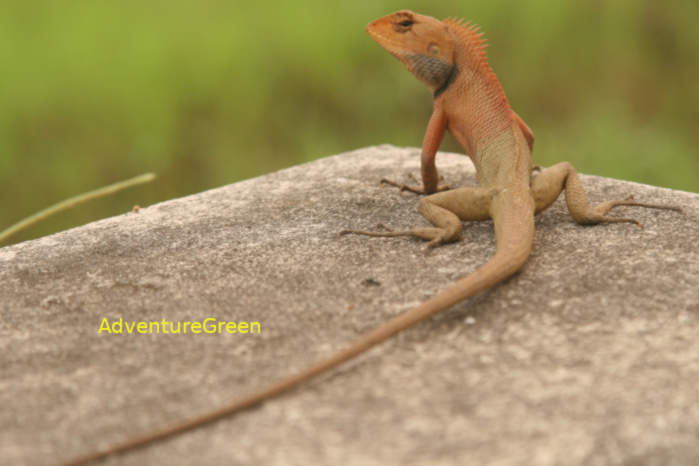
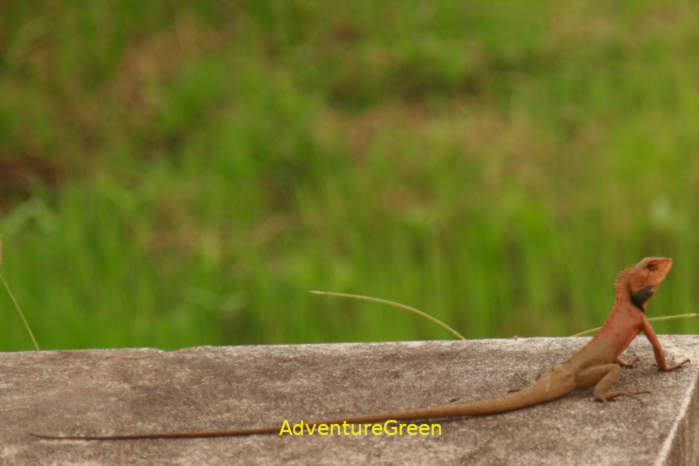
The oriental garden lizard (Calotes versicolor), also called the eastern garden lizard, Indian garden lizard, common garden lizard, bloodsucker or changeable lizard
The oriental garden lizard (Calotes versicolor) is an agamid lizard found widely distributed in Indo-Malaya.
The native range of the species includes southeastern Iran, Afghanistan, Bangladesh, Bhutan, Cambodia, India (including the Andaman Islands), Indonesia (Sumatra), Malaysia (western), Maldives, Mauritius (Reunion, Rodrigues), Myanmar, Nepal, Pakistan, Philippines, Sri Lanka (Ceylon), Thailand, Vietnam (including Pulo Condore Island).
Squamata is derived from the Latin word squamatus ("scaly, having scales"), which originates from squama ("scale"). It is the largest order of reptiles—including lizards and snakes—characterized by scaly skin that is shed periodically and movable quadrate bones.
Agamidae is derived from New Latin by combining the genus name Agama with the suffix -idae (indicating a zoological family, from Latin/Greek -ides, "descendant of"). The name stems from Agama, a term used for these lizards. The origin of the term Agama is unknown.
The genus name Calotes is derived from the Greek word Καλότης (Kalótës), meaning ‘beauty’, referring to the beautiful pattern of this genus.
"Versicolor" is a Latin adjective meaning "variously colored," "changing color," or "variegated". It is derived from versāre ("to turn") and color ("color"), implying a color that changes or turns.