


Vietnam Adventure Tours & Travel, Trekking, Bird Watching, Cycling Tours
Xuan Thuy National Park
-
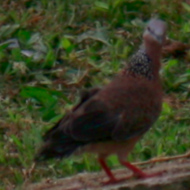
Spotted Dove
- Order: Columbiformes
- Family: Columbidae
- Genus: Spilopelia
Spotted dove (Cu gáy, Cu đất, Spilopelia chinensis)
Another name was Streptopelia chinensis.
Formerly included in the genus Streptopelia with other turtle-doves, but studies suggest that they differ from typical members of that genus. -
Spotted Redshank
- Order: Charadriiformes
- Family: Scolopacidae
- Genus: Tringa
Spotted redshank
(Choắt chân đỏ, Tringa erythropus)Spotted Redshank (Choắt chân đỏ, Tringa erythropus) is a wader (shorebird) in the large bird family Scolopacidae.
-
Swinhoe's Snipe
- Order: Charadriiformes
- Family: Scolopacidae
- Genus: Gallinago
Swinhoe's snipe,
(Dẽ giun Swinhoe, Gallinago megala), also known as forest snipe or Chinese snipeSwinhoe's snipe, (Gallinago megala) is a medium-sized, long-billed, migratory wader of the family.
The bird breeds mainly in central and southern Siberia and Mongolia. The entire population migrates and spends the non-breeding season principally in eastern and southern India, Sri Lanka, south-eastern China, South-East Asia and New Guinea.
The term Charadriiformes comes from New Latin, combining the Greek word kharadrios ("a bird of river valleys" or "a bird of ravines") and the Latin suffix -formes meaning "forms" or "shaped like". Therefore, Charadriiformes translates to "birds shaped like or resembling the charadrius," which is a type of plover or stone curlew historically found in dry river beds or ravines.
The word Scolopacidae is New Latin, derived from the genus name Scolopax (Latin for "snipe" or "woodcock") and the common zoological suffix for family names, -idae.
The genus name gallinago is Neo-Latin for a woodcock or snipe from Latin gallina, "hen" and the suffix -ago, "resembling".
-
Temminck's Stint
- Order: Charadriiformes
- Family: Scolopacidae
- Genus: Calidris
Temminck's stint
(Rẽ Lưng đen, Calidris temminckii)Temminck's stint (Calidris temminckii) is a small wader of the family Scolopacidae.
The bird breeds in the taiga of Arctic northern Europe and Asia; it is strongly migratory, wintering at freshwater sites in tropical Africa, the Indian subcontinent and parts of Southeast Asia.Charadriidae, Charadrius: Late Latin word for a yellowish bird mentioned in the fourth-century Vulgate; from Ancient Greek kharadrios a bird found in ravines and river valleys (kharadra, "ravine").
The word Scolopacidae is New Latin, derived from the genus name Scolopax (Latin for "snipe" or "woodcock") and the common zoological suffix for family names, -idae.
The genus name Calidris is from Ancient Greek kalidris or skalidris, a term used by Aristotle for some grey-coloured waterside birds.
The specific epithet is from the name of a Dutch naturalist Coenraad Jacob Temminck.
-
Terek Sandpiper
Terek sandpiper
(Choắt chân màng bé, Xenus cinereus)The Terek Sandpiper (Xenus cinereus, Choắt chân màng bé) is a small migratory wader species, family of Scolopacidae, genus Xenus. Terek Sandpiper is a pass-through winter bird commonly sighted at the Xuan Thuy National Park.
The bird breeds from Finland through northern Siberia to the Kolyma River, and migrates south in winter to tropical coasts in east Africa, south Asia and Australia.
The term Charadriiformes comes from New Latin, combining the Greek word kharadrios ("a bird of river valleys" or "a bird of ravines") and the Latin suffix -formes meaning "forms" or "shaped like". Therefore, Charadriiformes translates to "birds shaped like or resembling the charadrius," which is a type of plover or stone curlew historically found in dry river beds or ravines.
The word Scolopacidae is New Latin, derived from the genus name Scolopax (Latin for "snipe" or "woodcock") and the common zoological suffix for family names, -idae.
The bird English name is named after the Terek River which flows into the west of the Caspian Sea where it was first observed.
The genus name Xenus is from Ancient Greek xenos meaning "stranger".
The specific epithet cinereus is Latin for "ash-grey" from cinis, cineris, "ashes". -
Thick-billed Green Pigeon
- Order: Columbiformes
- Family: Columbidae
- Genus: Treron
Thick-Billed Green Pigeon
(Cu xanh mỏ quặp, Treron curvirostra)The thick-billed green pigeon is a species of bird in the family Columbidae.
Columbidae, Columba: Latin columba (“dove, pigeon”). Ancient Greek κόλυμβος (kólumbos, “a diver”), from κολυμβάω (kolumbáō, “dive, plunge headlong, swim”).
Pigeon is a French word that derives from the Latin pīpiō, for a "peeping" chick;
Dove is an ultimately Germanic word that refers to the bird's diving flight.
The genus name Treron is from the Ancient Greek trērōn meaning "pigeon" or "dove".
curvirostra is Latin for "curved bill". -
Todiramphus
- Order: Coraciiformes
- Family: Alcedinidae
Todiramphus is a genus of kingfishers in the subfamily Halcyoninae that are endemic to the Philippines, New Guinea, Australia, New Zealand and many islands in the South Pacific.
1/ Collared kingfisher(Sả khoang cổ, Todiramphus chloris), also white-collared kingfisher, black-masked kingfisher or mangrove kingfisher
Alcedo, Alcedinidae: Latin word for kingfisher.
The genus name Todiramphus literally means "tody-bill"; tody is a relative of the kingfishers with a similar slender long bill, and the Greek rhamphos (ῥάµϕος) means "beak" or "bill". -
Tufted Duck
- Order: Anseriformes
- Family: Anatidae
- Genus: Aythya
Tufted duck or tufted pochard (Vịt mào, Aythya fuligula)
The tufted duck (or tufted pochard) (Aythya fuligula) is a small diving duck found in northern Eurasia.
The duck is migratory in most of the range, and winters in the milder temperatures in southern and western Europe, southern Asia.The name Aythya comes from the Ancient Greek word authuia, which may have referred to a sea-dwelling duck or an auklet.
The epithet fuligula is Latin fuligo 'soot' and gula 'throat' meaning sooty-throated. -
Western swamphen
- Order: Gruiformes
- Family: Rallidae
- Genus: Porphyrio
- French: Talève sultane
Western swamphen
(Xít, Porphyrio porphyrio)The western swamphen (Porphyrio porphyrio) is a species of swamphen in the rail family Rallidae, one of the six species once referred to as the purple swamphen.
Gruiformes, Gruidae: from the Latin word grus meaning "crane".
Rallidae: from rallus new Latin for rail, an aquatic bird.
The genus name Porphyrio is the Latin name for "swamphen", meaning "purple". -
White-breasted Waterhen
- Order: Gruiformes
- Family: Rallidae
- Genus: Amaurornis
White-breasted waterhen
(Cuốc ngực trắng, Amaurornis phoenicurus)
The species name phoenicurus is from Ancient Greek phoinix, "red", and -ouros -"tailed".The white-breasted waterhen (Amaurornis phoenicurus) is a waterbird of the rail and crake family, Rallidae, that is widely distributed across South and Southeast Asia.
Gruiformes, Gruidae: from the Latin word grus meaning "crane".
Rallidae: from rallus new Latin for rail, an aquatic bird.
Amaurornis: the Greek amauros, meaning "dusky" or "brown", and ornis, meaning "bird". -
White-Throated Kingfisher
- Order: Coraciiformes
- Family: Alcedinidae
- Genus: Halcyon
White-throated kingfisher
(Sả đầu nâu, Halcyon smyrnensis)The white-throated kingfisher (Halcyon smyrnensis) also known as the white-breasted kingfisher is a tree kingfisher, widely distributed in Asia from the Sinai east through the Indian subcontinent to China and Indonesia.
-
Wood Sandpiper
- Order: Charadriiformes
- Family: Scolopacidae
- Genus: Tringa
Wood sandpiper (Choắt bụng xám, Tringa glareola)
The Wood Sandpiper (Tringa glareola, Choắt bụng xám) is a small wader in the large family Scolopacidae, sandpiper, Tringa genus. Wood Sandpiper is a pass-through winter bird commonly sighted at the Xuan Thuy National Park.
The term Charadriiformes comes from New Latin, combining the Greek word kharadrios ("a bird of river valleys" or "a bird of ravines") and the Latin suffix -formes meaning "forms" or "shaped like". Therefore, Charadriiformes translates to "birds shaped like or resembling the charadrius," which is a type of plover or stone curlew historically found in dry river beds or ravines.The word Scolopacidae is New Latin, derived from the genus name Scolopax (Latin for "snipe" or "woodcock") and the common zoological suffix for family names, -idae.
The name Tringa comes from the Ancient Greek word trungas, meaning "wader".
The specific epithet glareola is from Latin glarea, " gravel".
Glareola is a Latin word that means "gravel," derived from glarea, a diminutive of "gravel". The name likely refers to the patterns on the back of the bird.
Diminutive suffix: The name uses the diminutive suffix "-ola," turning "gravel" into "little gravel". -
Wood Snipe
- Order: Charadriiformes
- Family: Scolopacidae
- Genus: Gallinago
Wood snipe (Dẽ giun lớn, Rẽ giun lớn, Gallinago nemoricola)
The wood snipe (Gallinago nemoricola) is a species of snipe which breeds in the Himalayas of northern India, Nepal, Bhutan and southern China.
In winter, it occurs at lower altitudes in the Himalayas, as a regular visitor in small numbers to north Vietnam.
The term Charadriiformes comes from New Latin, combining the Greek word kharadrios ("a bird of river valleys" or "a bird of ravines") and the Latin suffix -formes meaning "forms" or "shaped like". Therefore, Charadriiformes translates to "birds shaped like or resembling the charadrius," which is a type of plover or stone curlew historically found in dry river beds or ravines.The word Scolopacidae is New Latin, derived from the genus name Scolopax (Latin for "snipe" or "woodcock") and the common zoological suffix for family names, -idae.
The scientific name gallinago is Neo-Latin for a woodcock or snipe from Latin gallina, "hen" and the suffix -ago, "resembling".
Nemoricola is a Latin term that means "woodland-dweller" or "forest-dweller". It is derived from the Latin word nemus, nemoris meaning "forest" or "woodland," and the Latin suffix -cola, meaning "inhabitant" or "dwelling".
-
Yellow-legged Buttonquail
- Order: Charadriiformes
- Family: Turnicidae
- Genus: Turnix
Yellow-legged buttonquail (Cun cút chân vàng, Cun cút lưng hung, Turnix tanki)
resemble, but are unrelated to, the true quails.The yellow-legged buttonquail (Turnix tanki) is a buttonquail, one of a small family of birds which resemble, but are unrelated to, the true quails.
The genus name is an abbreviation of the genus Coturnix.
Turnicidae is from Turnix abbreviation from genus Coturnix, quail(Coturnix is the Latin for the common quail); coined to reflect the quail-like appearance and lack of hind-toe.
hemipodes: Greek hemi half, semi; podes from Greek pous, podos foot (Latin pes).