


Vietnam Adventure Tours & Travel, Trekking, Bird Watching, Cycling Tours
Xuan Thuy National Park
-
Great Stone-Curlew, Great Thick-Knee
- Order: Charadriiformes
- Family: Burhinidae
- Genus: Esacus
Great stone-curlew or great thick-knee (Rẽ mỏ to, Esacus recurvirostris)
The great stone-curlew or great thick-knee (Esacus recurvirostris) is a large wader, a resident breeder in tropical southern Asia from India, Pakistan, Sri Lanka, Bangladesh, South-east Asia.
The bird is a visiting winter bird, uncommonly sighted at the Xuan Thuy National Park.
Charadriiformes, Charadriidae, Charadrius: Late Latin word for a yellowish bird mentioned in the fourth-century Vulgate; from Ancient Greek kharadrios a bird found in ravines and river valleys (kharadra, "ravine").Burhinidae is a taxonomic family of birds (stone-curlews/thick-knees) derived from New Latin Burhinus and the suffix -idae.
The name Esacus is from Ancient Greek aisakos an unidentified bird variously associated with a robin, a shorebird or a cormorant.
The specific epithet recurvirostris combines Latin recurvis meaning "bent backwards" with -rostris meaning "-billed".
-
Great White Pelican
- Order: Pelecaniformes
- Family: Pelecanidae
- Genus: Pelecanus
Great white pelican (Bồ nông trắng lớn, Pelecanus onocrotalus)
also known as the eastern white pelican, rosy pelican or simply white pelican
The great white pelican (Pelecanus onocrotalus) is a bird in the pelican family Pelecanidae.
The bird breeds from southeastern Europe through Asia and Africa.
This species migration is partially known with northern populations migrating to China, India, Myanmar, with stragglers reaching Java and Bali in Indonesia.
Pelecaniformes, Pelecanidae, Pelecanus
Pelecanus: Greek pelekan, pelekanos pelican.
Greek pelekan (πελεκάν), meaning "pelican" or related to "axe" (pelekys).
From pelekys (πέλεκυς), meaning "axe," likely due to the shape of the bill.
Onocrotalus comes from Ancient Greek derived from Greek ónos (donkey) + krótalon (rattle/clapper), humorously suggesting the sound of its flapping or the donkey-like braying of its voice, leading to its Latin adoption as "donkey-clapper". -
Greater Coucal
- Order: Cuculiformes
- Family: Cuculidae
- Genus: Centropus
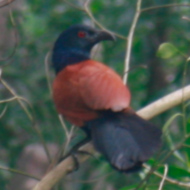
Greater coucal
or crow pheasant
(Bìm bịp lớn, Centropus sinensis)The greater coucal or crow pheasant (Centropus sinensis), is a large non-parasitic member of the cuckoo order of birds, the Cuculiformes.
The bird is a widespread resident in the Indian Subcontinent and Southeast Asia. -
Grey-headed Lapwing
- Order: Charadriiformes
- Family: Charadriidae
- Genus: Vanellus
Grey-headed lapwing (Te vàng, Vanellus cinereus)
The grey-headed lapwing (Vanellus cinereus) is a lapwing species which breeds in northeast China and Japan.
The bird species winters in northern Southeast Asia from northeastern India to Cambodia.Grey-headed lapwing (Te vàng, Vanellus cinereus) has a grey head and neck, darker grey breast band and white belly. The back is brown, the rump is white and the tail is black.
The term Charadriiformes comes from New Latin, combining the Greek word kharadrios ("a bird of river valleys" or "a bird of ravines") and the Latin suffix -formes meaning "forms" or "shaped like". Therefore, Charadriiformes translates to "birds shaped like or resembling the charadrius," which is a type of plover or stone curlew historically found in dry river beds or ravines.
The family name Charadriidae has the same origin as the order name from the Greek word kharadrios ("a bird of river valleys" or "a bird of ravines").
Vanellus is a Latin word meaning "little fan". The name refers to the sound of the wings in flight, which was compared to the sound of a winnowing fan. It is a diminutive of the Latin word vannus (“fan for winnowing grain”).
In Latin, cinereus means "ash-colored," "ash-gray," or "resembling ashes". It comes from the Latin word cinis, which means "ashes".
-
Greylag Goose
- Order: Anseriformes
- Family: Anatidae
- Genus: Anser
Greylag goose (Ngỗng xám, Anser anser) is a species of large goose in the waterfowl family Anatidae and the type species of the genus Anser.
Greylag goose or graylag goose
(Ngỗng trời, Ngỗng xám, Anser anser)The greylag goose (Anser anser) is a species of large goose in the waterfowl family Anatidae and the type species of the genus Anser.
The bird's distribution is widespread in Europe and Asia some of which often migrate southwards to spend the winter in warmer places, and many of which are resident, even in the north.
anas, anatis: Latin duck.
The genus name Anser comes from the Latin word anser meaning "goose". -
Indian Cuckoo
- Order: Cuculiformes
- Family: Cuculidae
- Genus: Cuculus
Indian cuckoo
( Bắt cô trói cột, Cuculus micropterus)The Indian cuckoo or short-winged cuckoo (Cuculus micropterus) is a member of the cuckoo order of birds, the Cuculiformes.
The bird is found in the Indian subcontinent and Southeast Asia.The genus name Cuculus is the Latin word for "cuckoo".
micropterum, Micropterus, micropterus Greek mikroptera small-winged. -
Indian Spot-billed Duck
- Order: Anseriformes
- Family: Anatidae
- Genus: Anas
Indian spot-billed duck (Vịt trời, Vịt mỏ đốm, Anas poecilorhyncha)
The Indian spot-billed duck (Anas poecilorhyncha) is a species of large dabbling duck that is a non-migratory breeding duck throughout freshwater wetlands in the Indian subcontinent.
The English name is derived from the red spot at the base of the bill that is found in the mainland Indian population.Traits:
- Bill: black, yellow-tiped, red-based;
- Wings: with a dark green patch bordered by white and black.The name Anas is the Latin for "duck".
The specific epithet poecilorhyncha combines the classical Greek words poikilos meaning "pied" or "spotted" and rhunkhos meaning a "bill". -
Jack Snipe
- Order: Charadriiformes
- Family: Scolopacidae
- Genus: Lymnocryptes
Jack snipe or jacksnipe (Rẽ giun nhỏ, Lymnocryptes minimus)
The jack snipe or jacksnipe (Lymnocryptes minimus) is a small wader of the family Scolopacidae.
The term Charadriiformes comes from New Latin, combining the Greek word kharadrios ("a bird of river valleys" or "a bird of ravines") and the Latin suffix -formes meaning "forms" or "shaped like". Therefore, Charadriiformes translates to "birds shaped like or resembling the charadrius," which is a type of plover or stone curlew historically found in dry river beds or ravines.
The word Scolopacidae is New Latin, derived from the genus name Scolopax (Latin for "snipe" or "woodcock") and the common zoological suffix for family names, -idae.
The genus name Lymnocryptes is from Ancient Greek limne, "marsh" and kruptos, "hidden".
The species name minimus is from Latin and means "smallest". -
Japanese Quail
- Order: Galliformes
- Family: Phasianidae
- Genus: Coturnix
Japanese quail (Cay Nhật Bản, Coturnix japonica)
The Japanese quail (Coturnix japonica), also known as the coturnix quail, is a species of Old World quail found in East Asia.
-
Large Hawk-Cuckoo
- Order: Cuculiformes
- Family: Cuculidae
- Genus: Hierococcyx
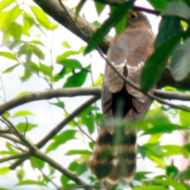
previously assigned as Cuculus sparverioides
The large hawk-cuckoo (Hierococcyx sparverioides, Chèo chẹo lớn) is a species of cuckoo in the family Cuculidae.
This bird species is found in Bangladesh, Bhutan, Cambodia, China, India, Indonesia, Laos, Malaysia, Myanmar, Nepal, Pakistan, the Philippines, Singapore, Taiwan, Thailand, and Vietnam. -
Lesser Coucal
- Order: Cuculiformes
- Family: Cuculidae
- Genus: Centropus
Lesser coucal
(Bìm bịp nhỏ, Centropus bengalensis)The lesser coucal (Centropus bengalensis) is a species of cuckoo in the family Cuculidae.
The species is widely distributed west from the Indian subcontinent (except for Sri Lanka) extending east across Southeast Asia.Compare:
- The greater coucal or crow pheasant (Centropus sinensis): red-eyed, big-sized;
- The lesser coucal (Centropus bengalensis): black-eyed, medium-sized;Cuculus: Latin for cuckoo.
The genus Centropus name combines the Ancient Greek: kentron meaning "spur" or "spike", pous meaning "foot". -
Little Buttonquail
- Order: Charadriiformes
- Family: Turnicidae
- Genus: Turnix
Little buttonquail (Cun cút bé, Turnix velox)
The little buttonquail (Turnix velox) is a species of buttonquail family Turnicidae.
Charadriidae, Charadrius: Late Latin word for a yellowish bird mentioned in the fourth-century Vulgate; from Ancient Greek kharadrios a bird found in ravines and river valleys (kharadra, "ravine").
Turnicidae is from Turnix abbreviation from genus Coturnix, quail(Coturnix is the Latin for the common quail); coined to reflect the quail-like appearance and lack of hind-toe.
The genus name Turnix is an abbreviation of the genus Coturnix.The family Turnicidae is also referred to as hemipodes which , in Greek, means hemi half, semi; podes from Greek pous, podos foot (Latin pes).
Velox is a Latin word meaning "swift, quick, rapid,speedy" or "fleet" deriving from a root related to motion; it's the source of English words like "velocity".
-
Long-toed Stint
- Order: Charadriiformes
- Family: Scolopacidae
- Genus: Calidris
Long-toed stint (Rẽ ngón dài, Calidris subminuta)
The long-toed stint (Calidris subminuta) is a small wader of the family Scolopacidae.
The bird breeds across northern Asia and is strongly migratory, wintering in south and south east Asia and Australasia.Charadriidae, Charadrius: Late Latin word for a yellowish bird mentioned in the fourth-century Vulgate; from Ancient Greek kharadrios a bird found in ravines and river valleys (kharadra, "ravine").
The word Scolopacidae is New Latin, derived from the genus name Scolopax (Latin for "snipe" or "woodcock") and the common zoological suffix for family names, -idae.
The genus name Calidris is from Ancient Greek kalidris or skalidris, a term used by Aristotle for some grey-coloured waterside birds.
The specific subminuta is from Latin sub, "near to" and minuta, "small" from its similarity to the little stint, Calidris minuta. -
Mallard
- Order: Anseriformes
- Family: Anatidae
- Genus: Anas
Mallard or wild duck (Vịt cổ xanh, Anas platyrhynchos)
The mallard or wild duck (Anas platyrhynchos) is a dabbling duck that breeds throughout the temperate and subtropical Americas, Eurasia, and North Africa.
Males (drakes) have green heads, while the females (hens) have mainly brown-speckled plumage.
Both sexes have an area of speculum feathers on their wings; males especially tend to have blue speculum feathers.The name Anseriformes is derived from the New Latin word Anser, meaning "goose," and the Latin suffix -formes, meaning "having the form of".
The name Anas is the Latin for "duck".
The scientific epithet platyrhynchos comes from Latin Anas, "duck" and Ancient Greek πλατυρυγχος, platyrhynchus, "broad-billed" (from πλατύς, platys, "broad" and ρυγχός, rhunkhos, "bill"). -
Marsh Sandpiper
Marsh sandpiper
(Choắt đốm đen, Tringa stagnatilis)The marsh sandpiper (Tringa stagnatilis) is a small wader of the family Scolopacidae.
The bird breeds in the Palearctic from easternmost Europe to the Russian Far East.
This species is migratory with a majority of birds wintering in Africa and India, and some migrating to Southeast Asia and Australia.The term Charadriiformes comes from New Latin, combining the Greek word kharadrios ("a bird of river valleys" or "a bird of ravines") and the Latin suffix -formes meaning "forms" or "shaped like". Therefore, Charadriiformes translates to "birds shaped like or resembling the charadrius," which is a type of plover or stone curlew historically found in dry river beds or ravines.
The word Scolopacidae is New Latin, derived from the genus name Scolopax (Latin for "snipe" or "woodcock") and the common zoological suffix for family names, -idae.
The name Tringa is the Neo-Latin name given to the green sandpiper based on Ancient Greek trungas, a thrush-sized, white-rumped, tail-bobbing wading bird mentioned by Aristotle.
The specific epithet stagnatilis is from Latin stagnum, "swamp".
-
Milky Stork
- Order: Ciconiiformes
- Family: Ciconiidae
- Genus: Mycteria
Milky stork (Cò lạo xám, Mycteria cinerea)
The milky stork (Mycteria cinerea) is a stork species inhabiting in mangroves in Southeast Asia.
The bird is native to Cambodia, Vietnam, Malaysia and Indonesia.The English name stork is derived from the Old English word storc (from at least 12th century).
Ciconiiformes, Ciconiidae, Ciconia: This is the Latin word for "stork", specifically referring to the White Stork (Ciconia ciconia).
The genus name Mycteria comes from the Ancient Greek word μυκτήρ (myktēr), meaning "snout," "nose," or "nostril". It is a New Latin genus name given to a type of stork, referencing the bird's prominent beak or bill, with the suffix -ia.
Cinerea comes from Latin, meaning "ash-like," "ash-colored," or "of ashes," derived from the Latin word cinereus, itself from cinis (ashes).
-
Nordmann's Greenshank
Nordmann's greenshank
(Choắt lớn mỏ vàng, Tringa guttifer) or the spotted greenshankNordmann's greenshank (Tringa guttifer) is a wader in the wader family Scolopacidae.
The Nordmann's greenshank breeds in eastern Russia.
The bird wintering time has been recorded in South Korea, mainland China, Hong Kong, and Taiwan on passage, and in Bangladesh, and South-East Asia.
The term Charadriiformes comes from New Latin, combining the Greek word kharadrios ("a bird of river valleys" or "a bird of ravines") and the Latin suffix -formes meaning "forms" or "shaped like". Therefore, Charadriiformes translates to "birds shaped like or resembling the charadrius," which is a type of plover or stone curlew historically found in dry river beds or ravines.The word Scolopacidae is New Latin, derived from the genus name Scolopax (Latin for "snipe" or "woodcock") and the common zoological suffix for family names, -idae.
The name Tringa is the Neo-Latin name given to the green sandpiper based on Ancient Greek trungas, a thrush-sized, white-rumped, tail-bobbing wading bird mentioned by Aristotle.
In Latin, guttifer (or guttifera) means "drop-bearing" or "resin/oil-bearing," combining gutta (drop) and ferre (to bear/carry), used botanically for plants producing latex or resin.
-
Northern pintail
- Order: Anseriformes
- Family: Anatidae
- Genus: Anas
Pintail or northern pintail
(Vịt mốc, Anas acuta)The pintail or northern pintail (Anas acuta) is a duck species with wide geographic distribution that breeds in the northern areas of Europe and across the Palearctic and North America.
anser: Latin anser goose;
anas, anatis: Latin duck.
The epithet acuta comes from the verb acuere meaning "to sharpen" which refers to the pointed tail of the male in breeding plumage. -
Northern shoveler
- Order: Anseriformes
- Family: Anatidae
- Genus: Spatula
Northern shoveler
(Vịt mỏ thìa, Spatula clypeata), known simply in Britain as the shovelerThe northern shoveler, known simply in Britain as the shoveler, is a common and widespread duck of the family Anatidae.
The species of this genus were formerly placed in the genus Anas.
anser: Latin anser goose;
anas, anatis: Latin duck.
The name Spatula is the Latin word for "spoon", from which the English word "spatula" also originates. -
Oriental dollarbird
- Order: Coraciiformes
- Family: Coraciidae
- Genus: Eurystomus
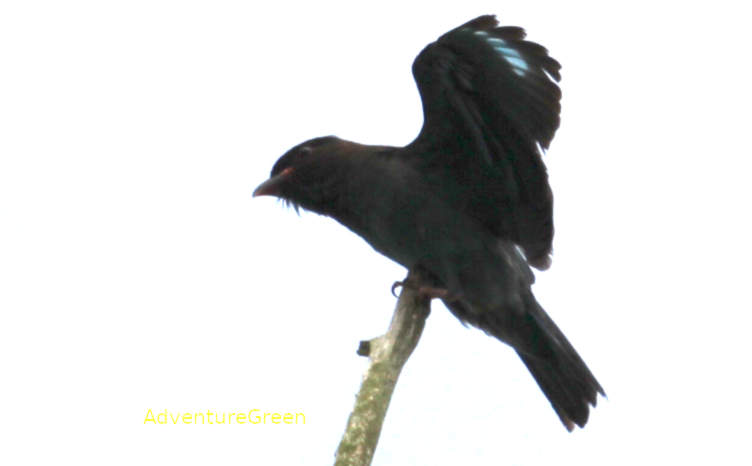
Oriental Dollarbird
Also known as Asian dollarbird, dark roller, dollar roller, dollarbird, eastern broad-billed roller and oriental broad-billed roller.
(Yểng Quạ, Eurystomus orientalis)