


Vietnam Adventure Tours & Travel, Trekking, Bird Watching, Cycling Tours
Psittacula
-
Alexandrine Parakeet
- Order: Psittaciformes
- Family: Psittaculidae
- Genus: Psittacula
Alexandrine parakeet (Vẹt má vàng, Psittacula eupatria), also known as the Alexandrine parrot
named after Alexander the Great.The Alexandrine parakeet (Psittacula eupatria) is a medium-sized parrot in the genus Psittacula of the family Psittaculidae, native to South Asia and Southeast Asia. The bird has feral populations in several countries in the Middle-East.
Psittaciformes comes from the Ancient Greek word ψιττακός (psittakós) meaning "parrot" combined with the Latin suffix -formes (shape/form), essentially meaning "parrot-shaped" or "of the parrot form," referring to the bird order containing parrots, cockatoos, and macaws.
The family name Psittaculidae comes from the Latin psittacus (parrot), which itself derives from the Ancient Greek word ψιττακός (psittakós), also meaning "parrot" with the suffix -ula indicating "little" or "diminutive," essentially meaning "little parrots" or "parakeets". It refers to Old World parrots like parakeets and lories.
Psittacula is a Latinized term meaning "little parrot" or "parakeet," derived from the Latin psittacus (parrot), which itself comes from the Ancient Greek word psittakós (ψιττακός) for parrot, plus the diminutive suffix -ula. The name of the genus is a diminutive of the Latin word psittacus for a "parrot".
The specific name eupatria is derived from the Ancient Greek words eu- meaning "well" and patria meaning "descent".
-
Blossom-headed Parakeet
- Order: Psittaciformes
- Family: Psittaculidae
- Genus: Psittacula
Blossom-headed parakeet
(Vẹt đầu hồng, Psittacula roseata)The Blossom-headed parakeet (Psittacula roseata or Himalayapsitta roseata) is a parrot in the family Psittaculidae.
The bird is a resident breeder in Southeast Asia. The range expands from eastern Bangladesh, Bhutan, northeast India and Nepal, eastwards into Cambodia, Laos, Myanmar, Thailand, Vietnam, and also China. This is a non-migratory bird living in the same range.Psittaciformes comes from the Ancient Greek word ψιττακός (psittakós) meaning "parrot" combined with the Latin suffix -formes (shape/form), essentially meaning "parrot-shaped" or "of the parrot form," referring to the bird order containing parrots, cockatoos, and macaws.
The family name Psittaculidae comes from the Latin psittacus (parrot), which itself derives from the Ancient Greek word ψιττακός (psittakós), also meaning "parrot" with the suffix -ula indicating "little" or "diminutive," essentially meaning "little parrots" or "parakeets". It refers to Old World parrots like parakeets and lories.
Psittacula is a Latinized term meaning "little parrot" or "parakeet," derived from the Latin psittacus (parrot), which itself comes from the Ancient Greek word psittakós (ψιττακός) for parrot, plus the diminutive suffix -ula. The name of the genus is a diminutive of the Latin word psittacus for a "parrot".
"Roseata" (or the adjective roseus) in Latin refers to something "rose-colored," "rosy," or "pink," derived from rosa (rose). It has roots in the Greek word rhodon (rose). The term is often used to describe a pinkish or blooming complexion.
-
Gray-headed Parakeet
- Order: Psittaciformes
- Family: Psittaculidae
- Genus: Psittacula
Grey-headed parakeet
(Psittacula finschii, Vẹt đầu xám)
closely related to the slaty-headed parakeet which together form a super-speciesThe grey-headed parakeet (Psittacula finschii) belongs to the genus Psittacula, also known as Afro-Asian ring-necked parrots - a genus of parrots from Africa and Southeast Asia. It is found in Southeast Asia from north-eastern India to Vietnam.
The name of the genus is a diminutive of the Latin word psittacus for a "parrot".
-
Long-tailed Parakeet
- Order: Psittaciformes
- Family: Psittaculidae
- Genus: Psittacula
Long-tailed parakeet (Vẹt đuôi dài, Psittacula longicauda)
The long-tailed parakeet (Psittacula longicauda) is a parakeet endemic to the regions of Andaman and Nicobar islands, Sumatra, Borneo and Peninsular Malaysia.
Psittaciformes comes from the Ancient Greek word ψιττακός (psittakós) meaning "parrot" combined with the Latin suffix -formes (shape/form), essentially meaning "parrot-shaped" or "of the parrot form," referring to the bird order containing parrots, cockatoos, and macaws.
The family name Psittaculidae comes from the Latin psittacus (parrot), which itself derives from the Ancient Greek word ψιττακός (psittakós), also meaning "parrot" with the suffix -ula indicating "little" or "diminutive," essentially meaning "little parrots" or "parakeets". It refers to Old World parrots like parakeets and lories.
Psittacula is a Latinized term meaning "little parrot" or "parakeet," derived from the Latin psittacus (parrot), which itself comes from the Ancient Greek word psittakós (ψιττακός) for parrot, plus the diminutive suffix -ula. The name of the genus is a diminutive of the Latin word psittacus for a "parrot".
The specific epithet longicauda combines the Latin longus meaning "long" and Latin cauda meaning "tail".
-
Psittacula
- Order: Psittaciformes
- Family: Psittaculidae
Members of the parrot genus Psittacula or Afro-Asian ring-necked parrots, as they are commonly known in aviculture, originate from Africa to South-East Asia. The name of the genus is a diminutive of the Latin word psittacus for a "parrot".
1/ Rose-ringed parakeet (Psittacula krameri), also known as the ringneck parrot (in aviculture) or the Kramer parrot
the specific krameri commemorates the Austrian naturalist Wilhelm Heinrich Kramer.2/ Blossom-headed parakeet (Vẹt đầu hồng, Psittacula roseata)
3/ Slaty-headed parakeet (Vẹt đầu xám, Psittacula himalayana)
4/ Long-tailed parakeet (Vẹt đuôi dài, Psittacula longicauda)
The specific epithet longicauda combines the Latin longus meaning "long" and cauda meaning "tail".5/ Alexandrine parakeet (Vẹt má vàng, Psittacula eupatria), also known as the Alexandrine parrot
named after Alexander the Great.
The specific name eupatria is derived from the Ancient Greek words eu- meaning "well" and patria meaning "descent".6/ Red-breasted parakeet (Vẹt ngực đỏ, Psittacula alexandri)
The specific epithet alexandri is from Alexander the Great whose soldiers introduced parakeets to Greece.7/ Grey-headed parakeet (Psittacula finschii)
-
Red-Breasted Parakeet
- Order: Psittaciformes
- Family: Psittaculidae
- Genus: Psittacula
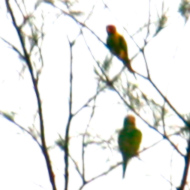
Red-Breasted Parakeet
(Vẹt ngực đỏ, Psittacula alexandri)The red-breasted parakeet (Psittacula alexandri) is a parrot native to Southeast Asia.
-
Rose-ringed Parakeet
- Order: Psittaciformes
- Family: Psittaculidae
- Genus: Psittacula
Rose-ringed parakeet
(Vẹt cổ hồng, Psittacula krameri), also known as the ringneck parrot (in aviculture) or the Kramer parrot
the specific krameri commemorates the Austrian naturalist Wilhelm Heinrich Kramer.The rose-ringed parakeet (Psittacula krameri) is a medium-sized parrot in the genus Psittacula, of the family Psittaculidae.
The bird has a disjunct native range in tropical northern Africa and the Indian subcontinent, introduced to other parts of the world through trade.Psittaciformes comes from the Ancient Greek word ψιττακός (psittakós) meaning "parrot" combined with the Latin suffix -formes (shape/form), essentially meaning "parrot-shaped" or "of the parrot form," referring to the bird order containing parrots, cockatoos, and macaws.
The family name Psittaculidae comes from the Latin psittacus (parrot), which itself derives from the Ancient Greek word ψιττακός (psittakós), also meaning "parrot" with the suffix -ula indicating "little" or "diminutive," essentially meaning "little parrots" or "parakeets". It refers to Old World parrots like parakeets and lories.
Psittacula is a Latinized term meaning "little parrot" or "parakeet," derived from the Latin psittacus (parrot), which itself comes from the Ancient Greek word psittakós (ψιττακός) for parrot, plus the diminutive suffix -ula. The name of the genus is a diminutive of the Latin word psittacus for a "parrot".
-
Slaty-headed Parakeet
- Order: Psittaciformes
- Family: Psittaculidae
- Genus: Psittacula
Slaty-headed parakeet
(Vẹt đầu xám, Psittacula himalayana)The slaty-headed parakeet (Psittacula himalayana) is a bird species of the parrot family Psittaculidae.
The species' range extends from Pakistan, to Western Himalayas in India through Nepal and Bhutan and up to the Eastern Himalayas in the northeastern Indian state of Arunachal Pradesh.Psittaciformes comes from the Ancient Greek word ψιττακός (psittakós) meaning "parrot" combined with the Latin suffix -formes (shape/form), essentially meaning "parrot-shaped" or "of the parrot form," referring to the bird order containing parrots, cockatoos, and macaws.
The family name Psittaculidae comes from the Latin psittacus (parrot), which itself derives from the Ancient Greek word ψιττακός (psittakós), also meaning "parrot" with the suffix -ula indicating "little" or "diminutive," essentially meaning "little parrots" or "parakeets". It refers to Old World parrots like parakeets and lories.
Psittacula is a Latinized term meaning "little parrot" or "parakeet," derived from the Latin psittacus (parrot), which itself comes from the Ancient Greek word psittakós (ψιττακός) for parrot, plus the diminutive suffix -ula. The name of the genus is a diminutive of the Latin word psittacus for a "parrot".